Minor Threat in Three Years: A Beginner's Guide to the D.C. Hardcore Band and Its Merch

Some bands take decades to leave a mark. Minor Threat needed about three years. The band formed in Washington, D.C. in 1980, split in 1983, and in between put out a run of short, fast hardcore punk records that people still pass from one generation to the next.
If the name keeps turning up on a sleeve, a playlist or a friend's T-shirt and you want the short version, this guide is for you: who the band were, the records worth knowing, and how the artwork on the Minor Threat designs connects to that story.
Who were Minor Threat?
Minor Threat was a hardcore punk band from Washington, D.C., formed in 1980. The lineup most people know:
- Ian MacKaye on vocals
- Jeff Nelson on drums
- Lyle Preslar on guitar
- Brian Baker on bass, later moving to second guitar
That move happened when Steve Hansgen joined on bass in 1982, a member many quick histories leave out. Baker returned to bass in 1983.
MacKaye and Nelson had already played together in the Teen Idles, and they ran Dischord Records, the label founded in December 1980 whose first release was the Teen Idles' Minor Disturbance. Every Minor Threat release came out on Dischord. That do-it-yourself setup, a band putting out its own music through a label its own members ran, is a big part of why the name still means something.
Which records should you start with?
The whole catalogue is short, which makes it a friendly place to begin. In order:
- Minor Threat (1981, Dischord 3): the first EP, and home of the song "Straight Edge".
- In My Eyes (1981): the second EP, released the same year.
- Out of Step (1983, Dischord 10): the last record released while the band was together.
- First Two Seven Inches (1984, Dischord 12): the two 1981 EPs gathered in one place.
- Salad Days (1985, Dischord 15): an EP released after the split.
Later came Minor Threat Live (1988), the Complete Discography collection in the late 1980s, First Demo Tape (2003) and Out of Step Outtakes (2023). If you want one place to start, go back to the 1981 debut EP: it is where "Straight Edge" lives, and it is over quickly.
What is the "Straight Edge" song about?
"Straight Edge" sits on that first 1981 EP. It is about choosing not to drink or take drugs, and it helped inspire the straight edge movement that grew up around that idea. One detail worth knowing: the band members have said they never set out to start a movement. The song took on a life of its own.
It is a good example of why Minor Threat still gets talked about. A track from a seven-inch record by a D.C. band ended up shaping how a lot of people thought about punk, music and how to live.
How did it end?
The band split in 1983, mainly over creative differences: Preslar and Baker were reported to want a direction closer to U2. The last show was on 23 September 1983 at the Lansburgh Cultural Center in Washington, D.C., on a bill with Trouble Funk and the Big Boys.
Three years, a few EPs and one final hometown show. That short life is part of the appeal: there is no long decline, just a tight burst of records that still sound urgent.
How does the artwork tell the story?
The look that goes with Minor Threat is raw and flyer-like: black, white and red, nothing polished. The designs in the Minor Threat collection keep to that feel, and several of them lean on images that suit the band's story.
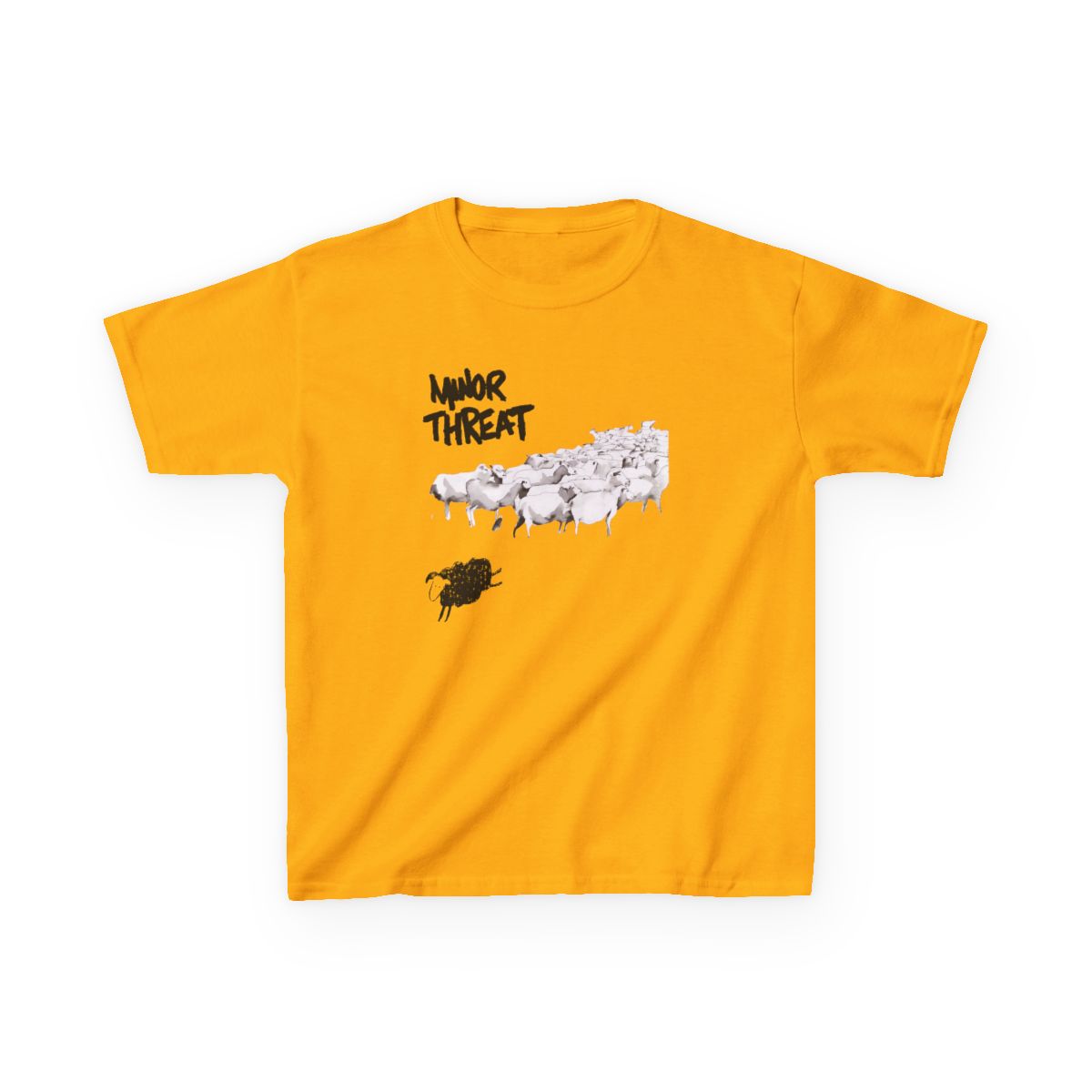
The black sheep. The Black Sheep Flock kids tee shows a grey flock of sheep with one scribbled black sheep leaping away from the rest, under the band's name. For a band with a record called Out of Step, a sheep breaking from the flock reads like the right image. The Major Threat Sheep design takes the same idea louder, with big red lettering around a leaping black sheep with red eyes.
The live moment. Minor Threat was a band you heard at its fastest in a small room. The Live Singer Cutout design catches that: a black-and-white live photo of a singer at the microphone beside a packed crowd, cut out in a cloud shape. On the Live Singer Cutout three-panel fleece hoodie it becomes a warm layer for colder evenings, and the same artwork comes on a kids tee too.
The name itself. If you want the plainest statement, the Red Block Wordmark design stacks the black Minor Threat name on two lines over a rough red block, the classic black, white and red in one piece.
The playful side. Not everything is stern. The Striped Cat Strut design has a cartoon cat in a striped tee and high-tops striding along with a raised fist, and Beach Rats has rows of scratchy grey lettering above a snarling cartoon rat head. Both are easy picks for younger listeners.
Who is this music, and this merch, a good fit for?
A few easy matches:
- The record collector who likes knowing the label history: Dischord, the catalogue numbers, the Teen Idles link. The Red Block Wordmark keeps it simple.
- The kid discovering punk through a parent's records: the kids' tees in the range, like the cat, the rats or the black sheep, are a gentle way in.
- The person who never quite fits the mould: the black sheep designs say it without a word.
- The one who loves live music: the Live Singer Cutout, on a tee or a hoodie.
Minor Threat lasted only from 1980 to 1983, but the records, the label and the ideas around them have travelled a long way since. Put on the first EP, give it fifteen minutes, and you will hear why.